
Irong-Irong Banwang Pinalangga: Civic Spectacle and the Making of Historical Consciousness
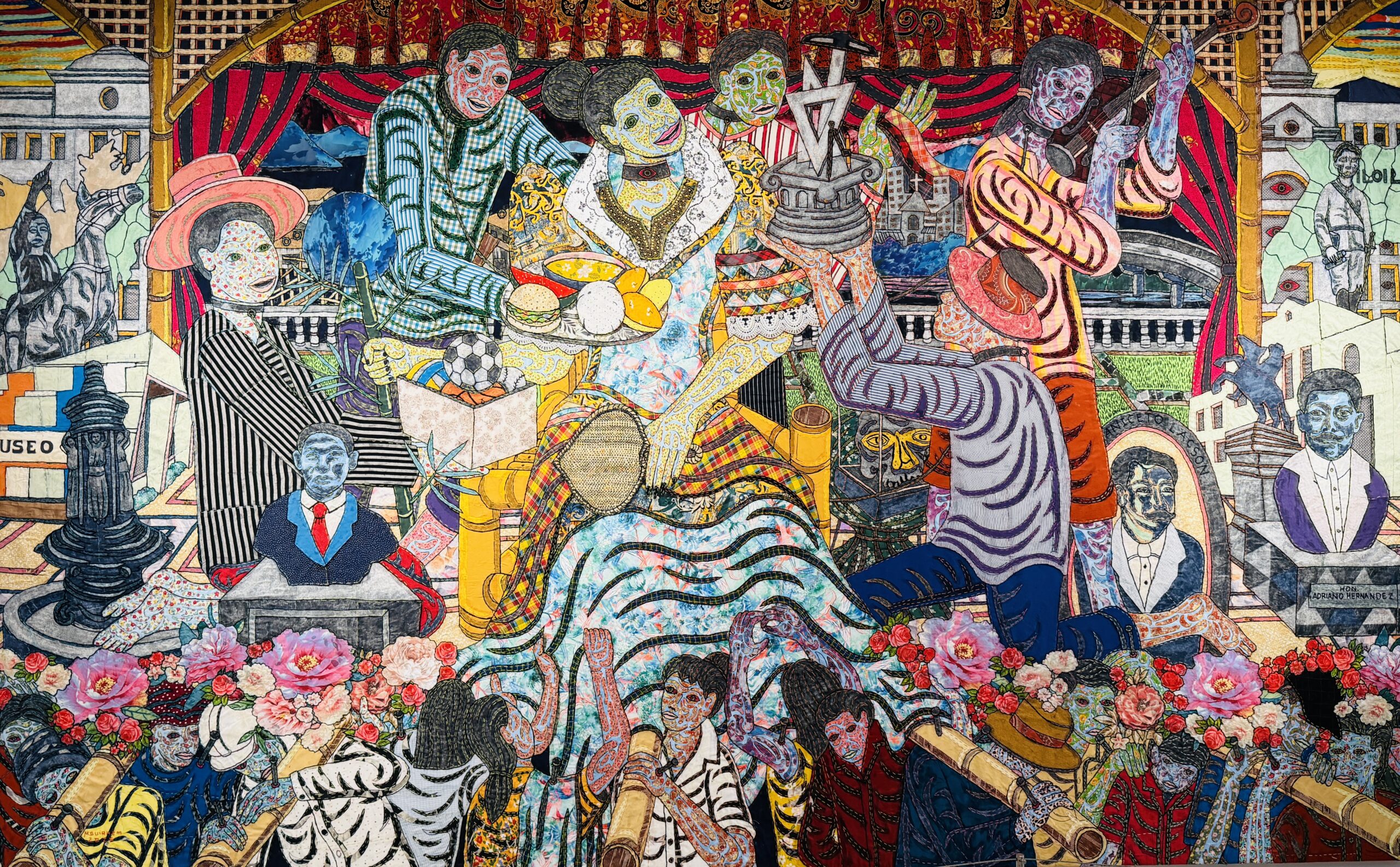
Irong-Irong Banwang Pinalangga (textile and thread on canvas, 13 × 8 feet, 2026) by Melvin C. Guirhem was unveiled on May 2, 2026, during the opening of the exhibition Patubas: Aning Ani: Works of Philippine Art Awards Laureates from the Edwin V. Valencia Collection at the Iloilo Museum of Contemporary Art (ILOMOCA). Guirhem is the 2020 Philippine Art Awards Grand Prize Winner.
Moments before his monumental 13-by-8-foot textile-and-fabric work on canvas entered public view, Melvin Guirhem sat in quiet contemplation, as though considering the many forces that continue to shape the city he sought to portray. The title invokes the city’s origin by recalling its earliest known name, Irong-Irong, a Hiligaynon/Kinaray-a term referring to the nose-shaped promontory formed by the Iloilo and Batiano Rivers, where the settlement first took root.
Early Spanish records rendered the name as Yrong-Yrong, reflecting sixteenth-century orthographic conventions before evolving into Ilong-Ilong and eventually being standardized as Iloilo by the nineteenth century. Across more than three centuries of Spanish rule, the settlement grew into one of the empire’s most important provincial centers, its civic identity, urban landscape, and political culture shaped by imperial administration, ecclesiastical authority, and the export economy.
The opening of the Port of Iloilo to international trade in 1855 under a royal order issued by the Supreme Spanish Government, followed by the arrival of British Vice-Consul Nicholas Loney on July 31, 1856, transformed the city’s economy. Through the introduction of modern milling technology, credit facilities, improved sugarcane varieties, and direct access to foreign markets, Loney catalyzed the rapid growth of the sugar industry in Iloilo and neighboring Negros, earning the city the title Queen City of the South and fostering an enduring image of refinement, prosperity, and civic prestige rooted in the wealth and influence of its landed elite.[1]
This prolonged period of Spanish dominion culminated in the Philippine Revolution of 1898. However, the city’s principal families, clergy, and local leaders largely remained loyal to the Spanish Crown, raising funds and dispatching a battalion to fight the Filipino revolutionaries of the Katipunan in Manila. The battalion received a spectacular send-off at Plaza Alfonso XII (now Plaza Libertad), marked by an elaborate parade-and-review attended by the local Spanish authorities and the Iloilo Ayuntamiento.[2]

Manifesting this colonial inheritance is the affectionate sobriquet City of Love, through which ideals of civility, gentleness, and hospitality were cultivated, explicitly invoked by the title Irong-Irong Banwang Pinalangga (Iloilo, Beloved City), which simultaneously gestures toward an imagined pre-colonial Iloilo through its use of Irong-Irong.
The artist collapses these converging identities into a mural-scale canvas that is at once an expression of civic affection and an invitation to historical contemplation, giving visual form to the city’s civic imaginary where, indeed, “the past is always present”: immediate in its spectacle of the beloved city, yet expansive in its political implications; celebratory in its visual rhetoric, yet critical in the historical questions it compels the viewer to confront.
This coalescence of historical time finds material expression through Guirhem’s distinct visual vocabulary of intricately hand-sutured textile fragments. Salvaged scraps of fabric are meticulously assembled, bringing historical figures, monuments, architectural landmarks, cultural emblems, and the anonymous laboring bodies into a seamless visual continuum. The tactile richness of the surface almost tempts the viewer to reach out and touch it, with each stitched fragment functioning simultaneously as fabric and sign, accumulating into a dense profusion of texture, pattern, and image. The eye is invited not merely to see but to linger, decipher, and almost listen. In both its panoramic ambition and opulent orchestration of historical narrative, the composition recalls the political allegories of Diego Rivera’s civic murals, while its ceremonial abundance conjures the theatrical pageantry of Paolo Veronese’s canvases.
Framed beneath a crimson velvet grand drape, crowned with a batik-print valance and suspended from bamboo poles, the composition assumes the ceremonial grandeur of a proscenium theatre animated by vernacular craftsmanship. The illusion is so complete—joyful in spirit and lyrical in rhythm—that one can almost hear the familiar strains of the Iloilo City Hymn [3] rising as the curtain lifts, announcing the opening act of Iloilo’s enduring civic narrative:
Iloilo, Iloilo
Dakbanwa kong nahamut-an
Iloilo, Iloilo
Bugal magpadulong diin man
Tampad nga magpabilin sa imo
Tungod palangga ko
Dakbanwang Iloilo, bugal ko!

The viewer’s gaze is drawn to the composition’s commanding focal point: an allegorical “Queen,” a present-day evocation of Iloilo’s historic honorifics. Enthroned upon a bamboo palanquin and arrayed in lavish ceremonial attire, presides with grace and sovereign authority. Ornate embellishments and richly embroidered textiles cascade in flowing folds, their surfaces animated by hablon and patadyong motifs that pay homage to the region’s weaving traditions. A finely woven buri pamaypay resting upon her lap completes the regalia, reinforcing an image of refinement long associated with colonial aristocracy and the local principalia.
Gravitating around her are civic devotees who hail her, kneel before her, and present offerings bearing the city’s cultural wealth: its gastronomic traditions, affirmed by its designation as a UNESCO Creative City of Gastronomy; its architectural heritage; its achievements in sports and the visual and performing arts; its musical legacy; and its enduring textile traditions.
Occupying the middle register amid the alegre de vivir are political figures who, in actuality, constitute the city’s patronage network. Their synchronized presence and rhetorical gestures allude to the visual language of contemporary political allegiance, invoking the ideals of gugma (love) and uswag (progress) to transform the celebratory tableau into an image of civic consensus.
More than a ceremonial vehicle, the bamboo palanquin assumes a quiet yet commanding significance. Inseparable from the allegorical queen it bears, it becomes the structural hinge between symbolic authority and the material conditions that sustain it. From this elevated center, the composition invites the eye to descend through a visually encoded social pyramid, whose carefully calibrated spatial arrangement renders hierarchy immediately legible. This calibrated verticality recalls what Desmond Morris identifies as the symbolic language of “high” and “low,” in which bodily elevation functions as a visual expression of hierarchy, authority, and social rank.
Across many societies—from the royal courts of Thailand and imperial China to the kingdoms of India, Japan, and West Africa—the palanquin functioned not merely as a means of transport but as a mobile architecture of aristocratic privilege, making social hierarchy physically visible through ritualized elevation. Guirhem appropriates this historical form within a distinctly Ilonggo context. Fashioned from bamboo, it embodies local material culture while assuming a richer metaphorical symbolism. Renowned for its resilience and flexibility, bamboo becomes an apt emblem for the persistence of the city’s colonial and feudal inheritances, suggesting how structures of political authority, landed wealth, and ecclesiastical influence continually adapt to changing historical circumstances while preserving their underlying social relations.


Only then does the eye arrive at the base of the composition, where the artist reveals the social foundation upon which this elevated order rests. Ornamental floral arrangements beautify the foreground, partially veiling the faces of the impoverished masses and toiling workers who stand shoulder to shoulder beneath the bamboo palanquin, literally bearing the weight of those elevated above them. Their physical exertion sustains the spectacle, yet their individuality is deliberately obscured, underscoring the largely unseen labor upon which civic prosperity depends. The composition thus redirects attention to those whose backbreaking work makes the city’s celebrated image possible, even as its honors, recognition, and public visibility accrue to those who occupy its summit.
Guirhem’s attention to those who quietly sustain the civic spectacle resonates with a broader current in contemporary Philippine art. In Antipas Delotavo’s Royal Street from Iloilo Variants (2023), artist and curator José Tence Ruiz writes of the portraits of working men and women dispersed along Calle Real as “not quite sure of where they are going, not quite a participant in the power that the locale exudes.” Through this observation, Ruiz locates the meaning of Delotavo’s hometown not in its celebrated architecture or official narratives but in the ordinary lives that traverse it. A similar concern animates Nunelucio Alvarado’s Kaupdanan sa Kampo, presented in Stories of Restoration, Songs of the Sea (2018), where the burden borne by Negros sugarcane workers becomes the principal subject of the composition. Rather than romanticizing agricultural labor, Alvarado foregrounds the physical demands imposed upon those whose work sustained the island’s sugar economy while remaining largely absent from its narratives of wealth and progress. Although conceived through different historical contexts and visual languages, these works share with Guirhem a critical insistence that the prosperity, prestige, and civic identity celebrated in public memory are ultimately borne by forms of labor that remain structurally indispensable yet persistently marginalized within official narratives of progress.
The surrounding wings and backdrop extend this hierarchical structure. Churches, museums, monuments, commemorative busts, and architectural landmarks compress multiple places and historical moments into a unified symbolic setting. Particularly revealing is the placement of the revolutionary figures: Aniceto Lacson and Adriano Hernández occupy the right of center, while Martin Delgado and an unlabeled contemporary bust suggestive of a familiar riverside monument stand to its left. Their arrangement subtly evokes the visual language of the political spectrum; yet because these figures ultimately inhabit the same commemorative space, ideological distinctions dissolve into a shared regional mythology, where conflicting histories are reconciled through the spectacle of shared remembrance.


Through these interconnected visual structures, the artist presents history not merely as a succession of completed epochs but to emphasize how the accumulation of social formations generate and reproduce political, social, and cultural capital across generations. This continuity is embodied in the persistence of familiar names, familial succession, patronage networks, and political dynasties, revealing that inherited structures of power continually adapt while preserving their underlying relations and interests.
The work marks a significant development within Guirhem’s artistic practice. The mural extends his sustained inquiry into the relationship between individual consciousness and collective memory. The artist’s concerns have steadily broadened throughout his oeuvre—from the interior landscape of the self explored in Aeternum Dolorem (2025), to the moral duality of evil residing within both institutions and the human soul in Aswang ng Loob (2026), before ultimately shifting away from the individual to position the city itself as a symbolic organism through which memory, history, class, and political authority converge within a single civic image.
This widening of perspective is equally evident beyond Guirhem’s studio practice. Through Puluy-an Art Space, his exhibitions have consistently treated art as a site of social inquiry rather than aesthetic display alone. Most recently, Makinaryo, organized in collaboration with Sangdiwa to commemorate International Labor Day, examined labor, class relations, and economic inequality. The same critical commitment informed Art Pest: Society of Creative Puppets in the String of Monsters, staged independently during the Iloilo Arts Festival in 2024 after Guirhem and several fellow artists withdrew from the official program. Conceived as a symbolic funeral procession centered on a coffin installation, the intervention became both protest and public reflection, examining the complex relationships among government institutions, cultural organizations, private partners, and the artistic communities negotiating these overlapping structures of power.
Viewed against the longue durée of Iloilo’s history, this movement away from institutional centers toward community-based spaces assumes particular historical significance. More than a century earlier, Martín Delgado and the Ilonggo revolutionaries against Spain similarly displaced the locus of political authority from the colonial capital to Santa Barbara, where the Revolutionary Government of the Visayas was inaugurated on November 17, 1898 [4] marking the first raising of the Philippine flag outside Luzon.[5] Although separated by time and circumstance, both moments derive their significance from acts of decentering. Instead of confronting established authority solely within its own institutions, they create alternative spaces from which different social and political imaginaries become possible. In Guirhem’s case, this act of decentering is neither territorial nor revolutionary in the conventional sense but critical—an aesthetic decentering that seeks not to overthrow inherited structures of power but to render them historically visible.
Through this aesthetic act of decentering, Irong-Irong Banwang Pinalangga transforms civic spectacle into a mode of historical reflection. The mural sustains the tensions between celebration and critique, heritage and inequality, memory and power, allowing these contradictions to become the very condition of historical and social consciousness. The beloved city consequently emerges not as a fixed inheritance or a completed historical narrative but as an unfinished historical project, continually shaped by the histories it remembers as much as by those it leaves unresolved. Its enduring achievement lies in making those tensions visible, leaving the city’s inherited systems, hierarchies, and civic imaginaries open to continual scrutiny, negotiation, contestation, and reimagination—and the beloved city itself open to being imagined anew.
Sources and Readings:
I. Primary Sources and Historical Records
1 National Historical Commission of the Philippines. Port of Iloilo. Historical Marker. National Registry of Historic Sites and Structure. September 29, 1975. https://philhistoricsites.nhcp.gov.ph/registry_database/port-of-iloilo/
2 Hernández, Policarpo F. Iloilo, the Most Noble City: History and Development, 1566–1898. Quezon City: New Day Publishers, 2008.
3 Sangguniang Panlungsod of Iloilo City. Regulation Ordinance No. 2011-274: An Ordinance Adopting the “Himno sang Dakbanwa sang Iloilo” Composed by Arne Lubasan, as the Official City Hymn. Iloilo City, March 23, 2011. https://www.scribd.com/document/344073693/Iloilo-City-Regulation-Ordinance-2011-274?
4 Public Information and Community Affairs Office. “Cry of Sta. Barbara.” Iloilo Provincial Government, June 12, 2025. https://www.iloilo.gov.ph/index.php/en/culture-news/cry-santa-barbara?
5 Momblan, Gail. “Iloilo Remembers First PH Flag-Raising Outside Luzon.” Philippine News Agency, November 16, 2019. https://www.pna.gov.ph/articles/1086224
II. Philippine Social History, Elite Culture, and Class Formation
Benigno, Teodoro C. “The Philippines’ Elite.” Here’s the Score, The Philippine Star, July 20, 2001.
Francisco, Mariel H., and Fe Maria C. Arriola. The History of the Burgis. Quezon City: GCF Books, 1987.
McAdam, Gina Consing, and Sioban Doran. Houses That Sugar Built. China: Oro Group Inc., 2023.
III. Art History, Visual Culture, and Social Representation
Flattley, Megan. “The History of Mexico: Diego Rivera’s Murals at the National Palace.” Smarthistory, September 22, 2020. https://smarthistory.org/mexico-diego-rivera-murals-national-palace/?
Hanson, Kate H. “The Language of the Banquet: Reconsidering Paolo Veronese’s Wedding at Cana.” InVisible Culture: An Electronic Journal for Visual Culture, No. 14 (Winter 2010). https://www.invisibleculturejournal.com/pub/language-of-the-banquet/release/1?
Morris, Desmond. Postures: Body Language in Art. London: Thames & Hudson, 2019.
Olah, Natalie. Class. London: Tate Publishing, 2021.
IV. Philippine Contemporary Art: Critical Essays and Exhibition Texts
Flores, Patrick D. “Headlong.” In Sensible Form: Essays. Quezon City: ArtPost Asia, 2025.
———. “Procedures and Political Inspirations.” In Every Step in the Right Direction. Quezon City: Everything’s Fine, Inc., 2022.
Genodepa, Martin. Aswang ng Loob. Exhibition essay for Melvin C. Guirhem’s 14th Solo Exhibition. Eskinita Art Farm, March 2026.
Ong, Ted Aldwin. Aeternum Dolorem. Exhibition essay for Melvin C. Guirhem’s 13th Solo Exhibition. Art Cube Philippines, 2025.
Ruiz, Jose Tence. Delotavo and the Will to Salient Juxtaposition. Exhibition essay for Antipas Delotavo’s 20th Solo Exhibition, Iloilo Variants. Iloilo Museum of Contemporary Art, 2023.
Sarmiento, Alice. Stories of Restoration, Songs of the Sea. Exhibition essay for Nunelucio Alvarado’s solo exhibition. Iloilo Museum of Contemporary Art, 2018.

