Ken Cadenas’ Matehan: Contemporary Portraits of the Masses
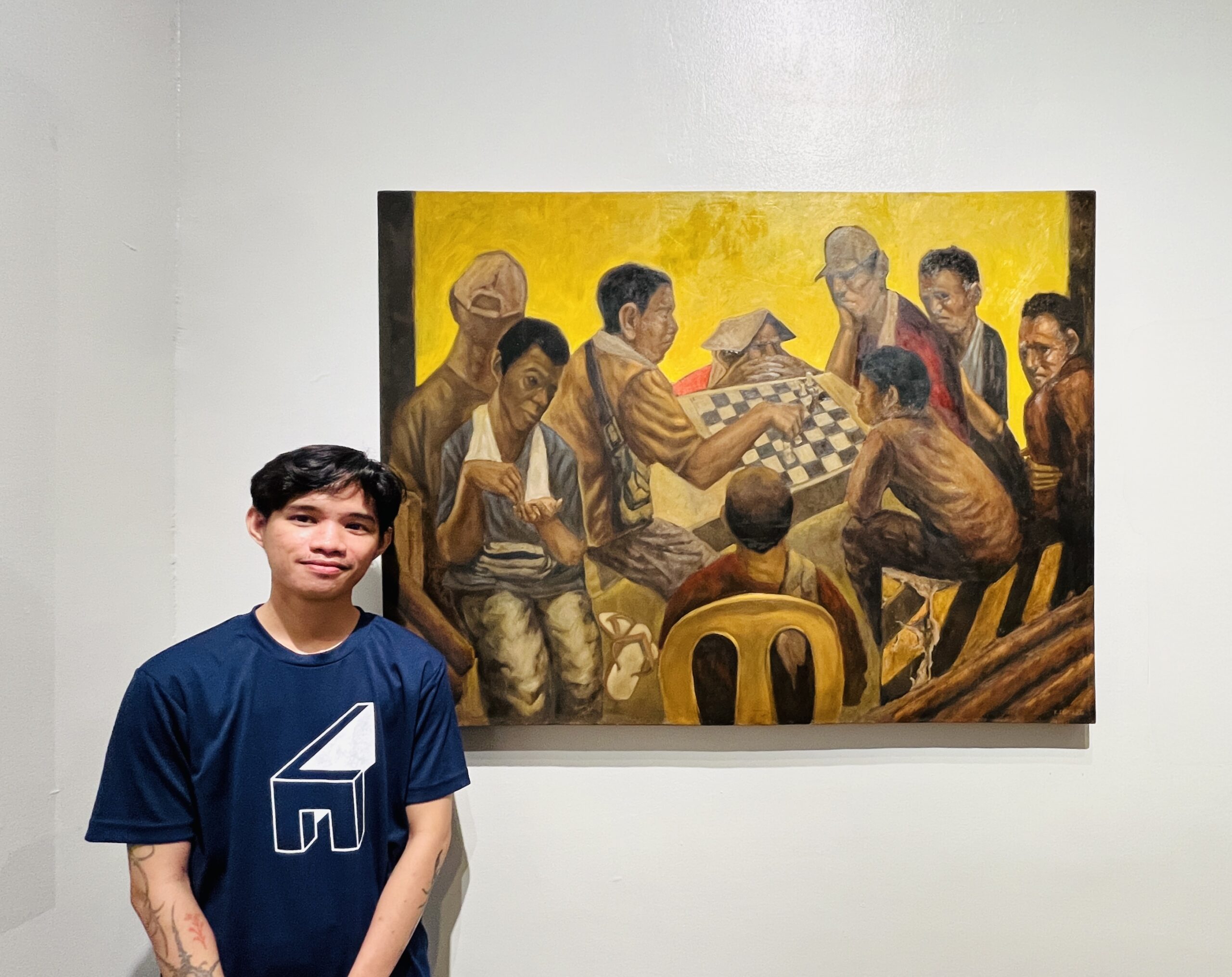
At a distance, Ken Cadenas’ “Matehan” immediately commands visual attention. Depicted in the 4 × 3–foot oil painting is a group of men—tricycle drivers—gathered around a worn chessboard at a transport-stop tambayan. Gawkers hover over the game, watching what appears to be a familiar pastime during the slow hours of off-peak labor.
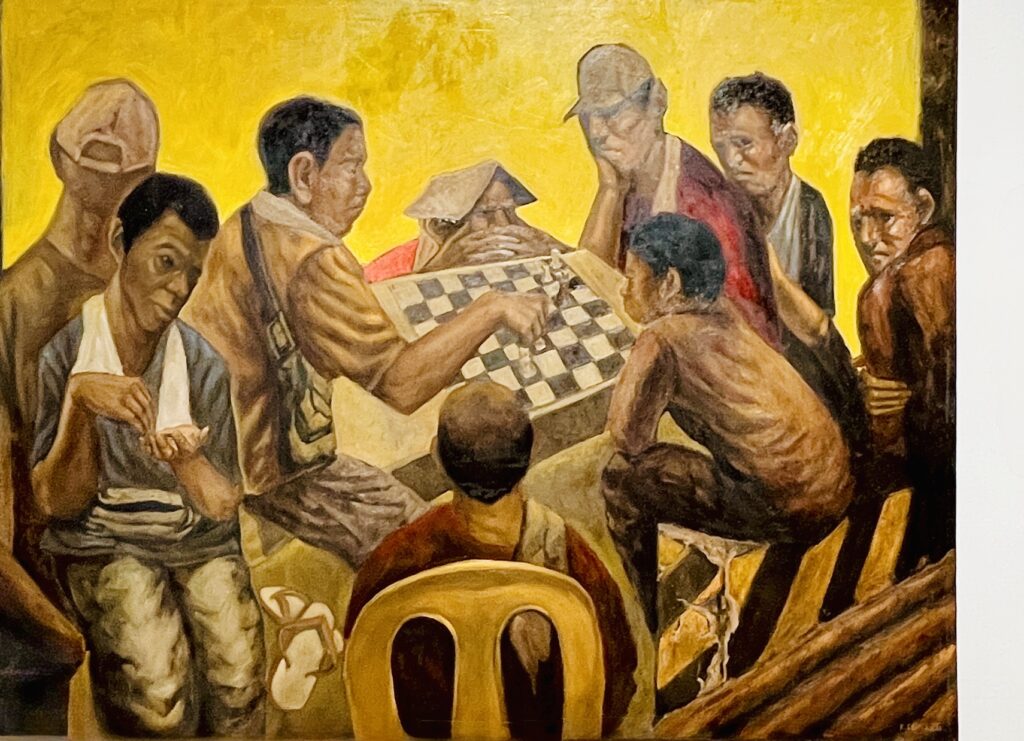
We are familiar with this everyday scene, having passed by similar dusty roadside corners ourselves. Yet Cadenas expands the subject, inviting viewers—us—to pause and take a closer look at what initially appears mundane. By rendering this ordinary moment on canvas, he seeks to awaken social consciousness, transforming the paralysis born of moral apathy, indifference, and passivity among Filipinos into a call toward awareness and action.
We need not look far to distant violence such as the bombings in Gaza, war in Ukraine, ICE raids on American homes, or scenes of famine in Sudan to confront social realities. Agony exists just around the corner, in spaces once dismissed as empty lots filled with litter and waste, repurposed into a tambayan. It is within these ordinary, overlooked spaces that lived struggles quietly unfold, insisting that social consciousness begins not elsewhere, but exactly where we stand.
Also read: Kikik Kollektive’s Ipaambit and The Tapestry of Becoming
A Hiligaynon street term, “matehan” refers to a casual, good-natured chess match in which the game is less about winning than about passing time. The player who loses is described as “namati,” a term commonly used in verbal exchanges, as in “namati ko siya sa chess,” meaning “he lost the game to me.”
As one lingers before the painting, the faces become clearer; voices and conversations seem to grow audible—the banter, playful teasing, and friendly ribbing. Familiar scents emerge: instant coffee, cigarette smoke curling through the air, the oily tang of gasoline clinging to fabric, and the work-worn mixture of salt and heat—perspiration baked into cotton shirts by long hours on the road.
Paintings often resonate most when they are grounded in shared experience, allowing meaning to surface through recognition. This was evident in the audience’s response to Matehan during the Linangan Art Residency Iloilo Batch Samo-Samo exhibition, where viewers found their own lives reflected on the canvas.
It is this quiet ordinariness, so deeply familiar and yet so rarely examined, that has made Matehan a widely applauded work.
Contemporary Portraiture
“I’m really fascinated by the everyday lives of ordinary people,” explains Cadenas who is a fourth year Fine Arts at the University of San Agustin.
“I want to render them on canvas as portraits that tell the stories of their lives with their old, worn-out clothes, the environments they move within, and the emotions and expressions on their faces,” Cadenas added.
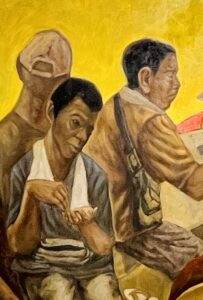
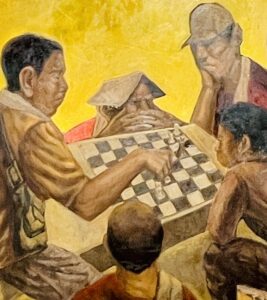
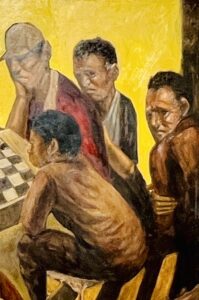
In Ken Cadenas’ Matehan, ordinary everyday scene becomes a potent metaphor for social and philosophical reflection.
Matehan emerges from this attentiveness. As a frequent passerby at a tricycle drivers’ tambayan at the periphery of the Megaworld’s Iloilo Business Park, Cadenas once paused and found himself momentarily becoming a “meron”—an onlooker—to a chess game nearing its conclusion. In that brief moment, he observed the collective tension among the gathered tricycle drivers, their faces charged with anticipation as they awaited who would claim victory and who would quietly accept defeat.
“They looked at me,” he said, “perhaps wondering what I was doing there, why I was watching the game, and what had sparked my interest,” said Cadenas, whose hometown is Leon, Iloilo.
He captured this moment through one of the figures directly meeting the artist’s gaze, as if acknowledging the presence of an outsider. This subtle interaction highlights the tension arising from our penchant for spectatorship, making the observer aware of their role as both witness and intruder within the private world of the group.
Every move matters
Cadenas used the scene as a microcosm of society. “The chess game can be likened to the lives of the masses. An everyday struggle for survival, compressed onto a sidewalk stage and reflected by the chessboard. Every move matters. A good move promises victory in life, while a bad one brings defeat,” Cadenas shared.
At the center lies the board, 64 squares of constraint and possibility, standing in for a country where everyone must move within limits, no matter how expansive their dreams. Within this bounded world, the pieces take on familiar lives. The king, central yet fragile, commands attention while remaining perpetually vulnerable, much like our leaders today, whose authority is often challenged and whose decisions are closely scrutinized for their merits or criticized for their consequences.
The queen, on the other hand, moves with startling freedom, cutting across the board with ease, embodying power, influence, money, and connections that slip through rigid boundaries.
The pawns advance quietly in ranks, the everyday workers as frontliners: numerous, expendable, indispensable. Their losses are routine, yet each carries the distant promise of transformation, should patience and circumstance allow a crossing to the other side. A good education for children and a well-paid labor abroad becomes an emancipatory element. But the game cannot exist without them.
Around the board are gawkers. Voices rise, suggestions whispered, wrong moves mocked, strategies debated. This chorus is public opinion: loud and divided, insistently insightful, often contradictory, very much like social media today when everybody’s opinion appears significant.
The power of everyday moments
The painting of Cadenas recognizes the scene as a potent metaphor for social and philosophical reflection. The chess game mirrors life itself: a field of strategy, patience, and consequence, where every move carries weight and meaning.
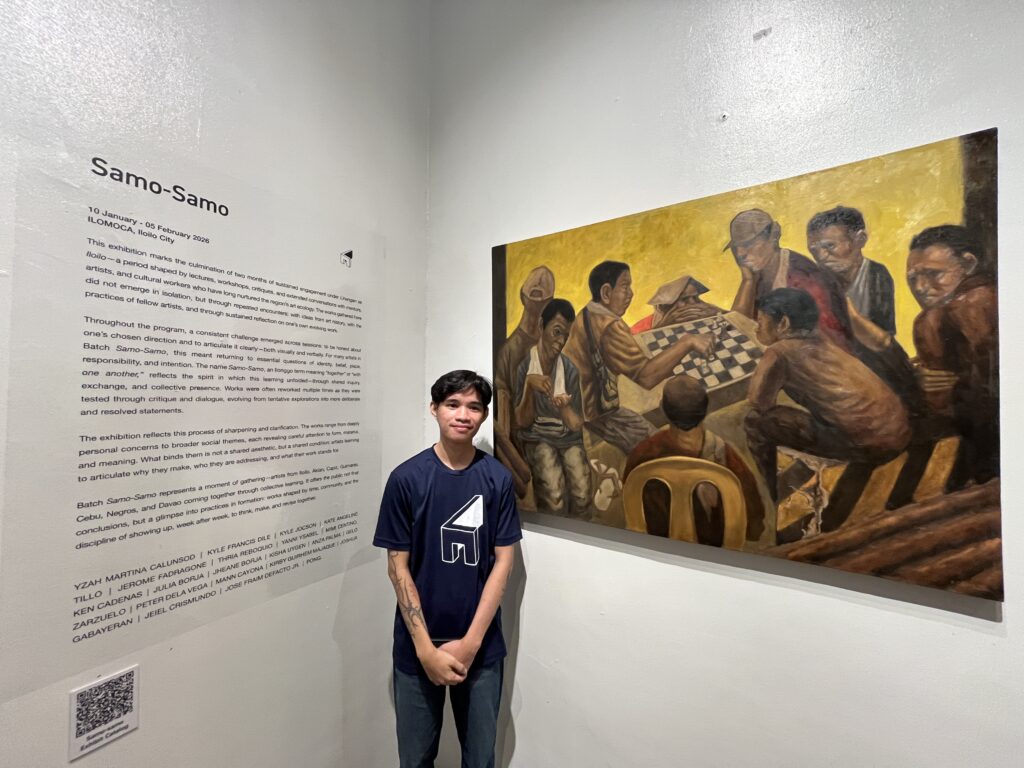
By placing everyday life on canvas, Cadenas declares that these seemingly ordinary moments matter. He transforms what is often unnoticed into something memorable, inviting viewers to pause, reflect, and consider the social realities that quietly shape daily existence.
The quiet power of Cadena’s work rests in what Linangan founder and mentor Manny Garibay describes as the artist’s “careful observation.” With an attentive eye tuned to the rhythms of everyday life, he renders ordinary social moments into scenes of quiet resonance, where meaning unfolds through patience, familiarity, and lived experience.
This rare attentiveness allows Cadenas to honor small, often overlooked details of daily life. In Matehan, the muted accuracy with which he depicted the gestures and interactions of tricycle drivers captures the essence of ordinary human activity, elevating it to a subject worthy of contemplation.
Ultimately, Matehan challenges viewers to look more closely at the world around them. It calls us to transform moral apathy and indifference into awareness, to recognize the significance in everyday life, and to engage with the social realities that unfold quietly, just beyond our immediate attention. The painting of Cadenas reminds us that reflection is the first step toward action, and that even the smallest moments can carry profound meaning if we choose to see them.
= = =
The feature story is published at the Daily Guardian on January 31, 2026. You can read it here: https://dailyguardian.com.ph/ken-cadenas-portraits-of-the-masses/